
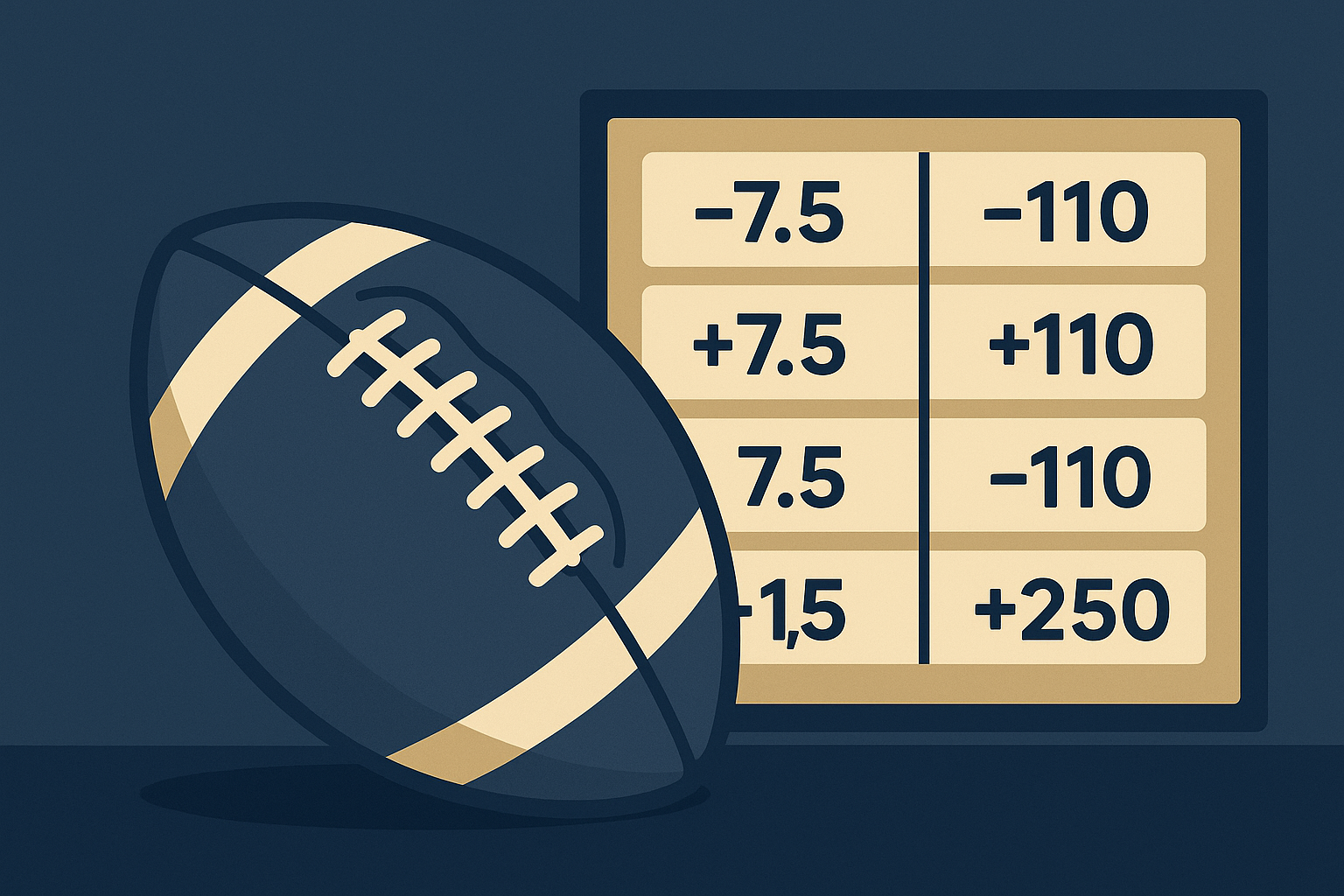
What is Super Bowl betting? (the basics)
Super Bowl betting is wagering real money on the outcome, margin, or specific events of the NFL’s championship game at a licensed sportsbook. That’s it. The confusing part isn’t the concept, it’s the notation: the plus and minus signs, the half-points, the three-digit prices. Once you can read those, everything else follows.
Here’s Super Bowl betting explained in one paragraph: the game is the single biggest betting event on the American calendar, and industry estimates from the American Gaming Association routinely put total wagering on it in the billions of dollars across legal sportsbooks and informal pools. A huge share of that money comes from people who bet once a year. That’s exactly why sportsbooks post hundreds of markets for this one game and almost none of them for a Week 4 Thursday nighter.
Nearly all of those markets fall into three buckets:
- Point spread — betting on the margin of victory, not just the winner.
- Moneyline — betting straight up on which team wins.
- Props — betting on specific events within the game (or around it), like a player’s yardage total or the coin toss.
There’s also the total (over/under) on combined points, futures markets that run all season, and live betting during the game. But if you understand spreads, moneylines, and props, you can read a Super Bowl odds board without asking anyone for help.
One thing to be clear about before the numbers: every market listed below carries a built-in house edge. Sportsbooks price both sides so the sum of the implied probabilities exceeds 100%. That gap is how they make money, and no guide, system, or tip sheet removes it.
How NFL point spreads work
An NFL point spread is a handicap the sportsbook applies to the favorite so that betting either team is roughly a coin flip. Say the Chiefs are listed at -3.5 against the Eagles at +3.5. The Chiefs must win by 4 or more for a Chiefs bet to cash. The Eagles cover if they win outright or lose by 3 or fewer.
The minus sign always marks the favorite; the plus sign marks the underdog. The number is the margin the favorite has to beat, or the cushion the underdog gets. A team can lose the game and still “cover” the spread, which is the part that trips up first-time bettors watching the fourth quarter.
Reading point spread odds
Next to the spread you’ll see a price, usually around -110. That’s the vig (also called juice), the sportsbook’s commission. At -110 you risk $110 to win $100. So a $100 bet on Chiefs -3.5 (-110) returns $190.91 if it wins: your $100 stake plus $90.91 profit.
Worked example. Suppose you take Eagles +3.5 (-110) for $50. The Chiefs win 27-24, a 3-point margin. The Eagles lost the game but covered the spread, so your bet wins. Payout: $50 stake + $45.45 profit = $95.45.
The -110 price on both sides is why spread betting is harder than it looks. Each side implies about a 52.4% chance, and the two together add up to roughly 104.8%. In practice, you need to win about 52.4% of your -110 bets just to break even. Coin-flip accuracy loses money over time.
Why spreads have half-points
The half-point, called the hook, exists to eliminate ties. If the spread were exactly -3 and the Chiefs won by 3, the bet would be a push and everyone gets their stake back. At -3.5, there’s a winner and a loser on every result.
That half-point matters more in the NFL than in any other sport because so many games are decided by 3 (a field goal) or 7 (a touchdown). Moving a line from -3 to -3.5 is a genuinely different bet, not a rounding detail. It’s the main reason it pays to compare a few sportsbooks before you place a wager.
Super Bowl moneyline betting explained
The moneyline is the simplest bet on the board: pick the team that wins the game. No margin, no handicap. Because the teams usually aren’t evenly matched, the sportsbook adjusts the price instead of the score.
Say the Chiefs are -150 and the Eagles are +130. Negative odds tell you what you must risk to win $100. Positive odds tell you what you win on a $100 risk.
| Bet | Odds | $100 stake profit | Total return | Implied win probability |
|---|---|---|---|---|
| Chiefs (favorite) | -150 | $66.67 | $166.67 | 60.0% |
| Eagles (underdog) | +130 | $130.00 | $230.00 | 43.5% |
Notice that 60.0% and 43.5% add up to 103.5%. That extra 3.5% is the overround, the sportsbook’s margin on this market. It’s the same mechanism as the house edge in a casino game, just expressed in odds instead of RTP.
Moneyline vs point spread: when to use each
The two bets answer different questions, so the choice depends on what you actually believe about the game.
| Point spread | Moneyline | |
|---|---|---|
| What you’re predicting | Margin of victory | Winner only |
| Typical price | Around -110 both sides | Varies with team strength |
| Best used when | You think one team wins comfortably, or the dog keeps it close | You think the underdog wins outright, or you want the simplest bet |
| Main drawback | Your team can win and you still lose | Heavy favorites pay very little |
Practical version: if you think the Eagles pull the upset, the +130 moneyline pays more than +3.5 against the spread. If you think the Chiefs win but it’s tight, the +3.5 underdog spread bet is the play. And when a Super Bowl favorite is priced at something like -400, the moneyline returns $25 profit on $100 while carrying real risk of losing the whole stake, which is why many bettors skip it entirely.
How Super Bowl prop bets work
A prop bet (short for proposition bet) is a wager on a specific occurrence rather than the final result. Josh Allen’s passing yards, whether the first score is a touchdown, how long the national anthem runs. Props are the reason the Super Bowl odds board is dozens of screens long.
Two things to know before you dive in. First, props are priced with wider margins than spreads and moneylines, because the sportsbook has less information and less liquidity on them. That means a higher effective house edge on the average prop than on the game line. Second, most people bet props for entertainment, and that’s a perfectly reasonable way to treat them, as long as the stake is money you’re fine losing.
Player performance props
These are over/under totals on individual stats. Typical examples:
- Quarterback passing yards, over/under 268.5
- Running back rushing yards, over/under 74.5
- Receiver receptions, over/under 5.5
- Anytime touchdown scorer (a yes/no market at plus odds)
- First touchdown scorer (long odds, one winner)
Player props usually carry vig near -115 or -120 on each side, which is worse than the -110 you’d pay on the spread. Small difference per bet, real difference across a card of ten props.
Game event props
Markets on things that happen during the game rather than on stat lines:
- Coin toss result (heads or tails, usually priced around -105 each side, a genuine 50/50 with vig attached)
- First scoring play type: touchdown, field goal, safety
- Whether the game goes to overtime
- Total field goals or total sacks
- Team to score first, or to score last
- Will there be a successful two-point conversion
Entertainment props
Depending on the state and the sportsbook, you may see markets on the national anthem length, the halftime show setlist, or the Gatorade shower color. These are novelty markets, and many regulated US sportsbooks either don’t offer them or offer only a limited set, because state regulators generally restrict betting on non-athletic events. Treat them as a party sideshow, not a strategy.
When Super Bowl betting odds come out
Full Super Bowl betting odds, spread, moneyline, and total, are typically posted within minutes to hours of the second conference championship game ending, roughly two weeks before the game. Most sportsbooks want a number up while people are still watching the trophy presentation.
Prop menus roll out more gradually. Core player props often appear in the following days; the long tail of exotic props tends to land in the final week, once injury designations and inactives are clearer.
You don’t have to wait for the matchup, though. Futures markets on the Super Bowl winner are available from before the season starts and update all year. A futures ticket bought in September carries longer odds but ties your money up for months, and an injury in Week 11 can leave you holding a worthless bet with no way to hedge cheaply.
Line movement and why odds change
The opening line is the sportsbook’s first estimate. From there it moves for two reasons: money and information.
- Betting volume. If most of the money lands on the favorite, the book shades the spread further to attract action on the other side and balance its exposure.
- News. A key starter ruled out, a change at quarterback, or extreme weather (less relevant in a dome, very relevant in an open-air Super Bowl) moves numbers fast.
Because different books take different money, their numbers rarely match exactly. You might find -3.5 (-110) at one, -3 (-115) at another, and +135 instead of +130 on the underdog. Having accounts at two or three legal sportsbooks and comparing before you bet, often called line shopping, is the one habit that measurably improves the price you pay. It doesn’t make a losing bet win, but it stops you overpaying on the bets you were going to make anyway.
Super Bowl betting tips for beginners
None of this is a system, and anyone selling you one is selling you a story. What follows is how to bet the Super Bowl without regretting it on Monday.
- Set the budget before kickoff, in dollars. Decide the total you’re willing to lose, treat it as the cost of entertainment, and don’t top it up mid-game.
- Start small and bet flat. Consistent unit sizes, say $10 or $20 a bet, beat “I feel good about this one” sizing. Ten small props are a better first experience than one big swing.
- Understand what -110 costs you. Needing 52.4% accuracy to break even is the honest math. Over enough bets, the vig grinds. Expect to lose more often than not.
- Never chase losses. Doubling up to recover a losing bet is how a $50 night becomes a $500 night. The next bet has no memory of the last one.
- Shop the line. Half a point on an NFL spread and 5 cents on a moneyline are real money over time.
- Read the bet slip before confirming. Check the team, the number, the price, and the stake. Live-betting mistakes are usually just misreads.
- Only use legal, regulated sportsbooks in your state. You must be 21 or older in nearly every US market. Regulated books have complaint procedures and mandated player protection tools; offshore sites don’t.
Every licensed sportsbook offers deposit limits, time limits, and self-exclusion. Use them proactively rather than after a bad night, and read our responsible gambling guide if you want the full set of tools explained. If betting has stopped being fun, or you’re wagering money you need, help is free and confidential: call or text 1-800-GAMBLER, or contact the National Council on Problem Gambling.
The Super Bowl is a fine place to learn how betting markets work. Just go in knowing the sportsbook’s edge is priced into every line on the board, and size your bets like you expect to lose them, because sometimes you will.
FAQ
What does the point spread mean in NFL betting?
It’s the margin of victory the favorite must beat. At Chiefs -3.5, a Chiefs bet needs a win by 4 or more; Eagles +3.5 wins if the Eagles win outright or lose by 3 or fewer.
How is a moneyline different from a spread?
The moneyline only asks who wins, with the price adjusted for team strength. The spread asks by how much, with both sides usually priced near -110.
How do Super Bowl prop bets work?
You bet on a specific event or stat rather than the result, such as a receiver going over 5.5 catches or the first score being a field goal. Props typically carry higher vig than the game line.
When do Super Bowl odds come out?
The spread, moneyline, and total usually appear within hours of the conference championships, about two weeks out. Props follow over the next week or two, and futures on the winner run all season.
21+ only. Gambling involves risk of loss, and no bet is a reliable source of income.