
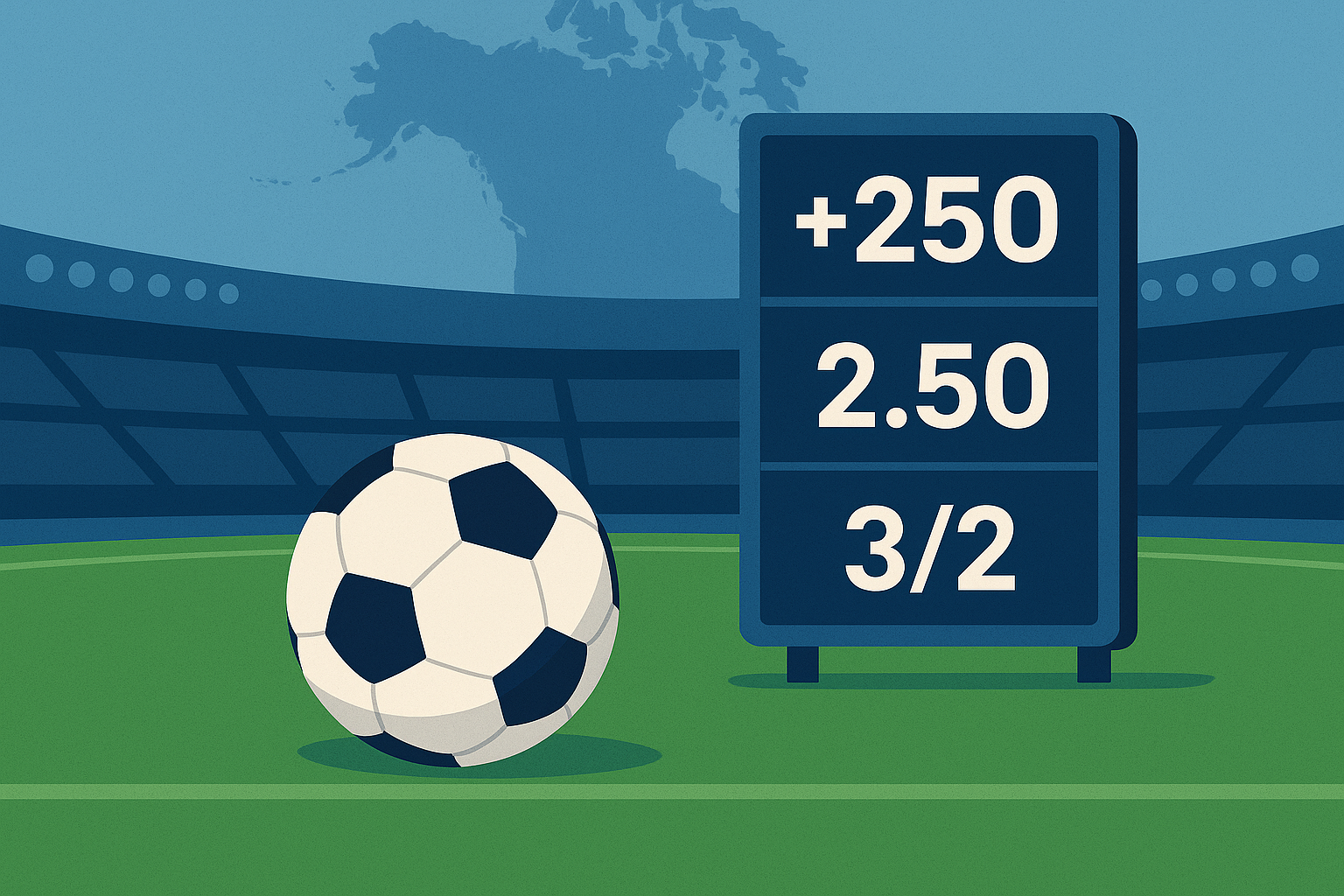
World Cup betting odds do two jobs at once: they tell you how much a bet pays, and they tell you what probability the sportsbook has attached to that outcome. Once you can read them both ways, everything else about betting the 2026 tournament, the three-way moneylines, the outright winner markets, the goal totals, starts making sense. This guide explains the mechanics, not predictions. No tips, no picks, just how the numbers work.
A quick note on the tournament itself, because the format changes how the markets look. The 2026 World Cup is co-hosted by the United States, Canada and Mexico, expands to 48 teams, and runs 104 matches across June and July 2026. Twelve groups of four feed into a round of 32. More teams and more matches means more markets, and a longer stretch of time for a casual bettor to lose track of what they’ve staked.
How World Cup betting odds work: the basics
Odds are a price. They express the payout on a winning bet and, implicitly, the chance the book gives that outcome. Every set of odds also contains the sportsbook’s built-in margin (the overround), which is why the implied probabilities across a market always add up to more than 100%. That margin is the house edge in betting form, and it’s the reason betting is a negative expected value activity over the long run.
Reading different odds formats
US sportsbooks default to American odds, but soccer coverage is full of decimal and fractional prices, so it helps to recognise all three.
- American (moneyline) odds: a plus number is the profit on a $100 stake. A minus number is the stake needed to win $100. So +250 wins $250 on $100; -150 needs $150 to win $100.
- Decimal odds: the total return per $1 staked, including your stake. 3.50 returns $3.50 for every $1, which is $2.50 profit.
- Fractional odds: profit relative to stake. 5/2 means $5 profit for every $2 risked.
Here’s how the same prices look across formats, with the implied probability each one represents:
| American | Decimal | Fractional | Implied probability |
|---|---|---|---|
| +300 | 4.00 | 3/1 | 25.0% |
| +150 | 2.50 | 3/2 | 40.0% |
| +100 | 2.00 | 1/1 | 50.0% |
| -150 | 1.67 | 2/3 | 60.0% |
| -250 | 1.40 | 2/5 | 71.4% |
The implied probability math is simple. For decimal odds, divide 1 by the price: 1 ÷ 4.00 = 0.25, or 25%. For a plus-money American price, it’s 100 ÷ (odds + 100), so +300 gives 100 ÷ 400 = 25%. For a minus price, it’s odds ÷ (odds + 100), so -150 gives 150 ÷ 250 = 60%.
Calculating your potential winnings
Payout math is the part people get wrong, usually by confusing profit with total return.
- Plus-money American odds: profit = stake × (odds ÷ 100). A $25 bet at +260 returns $65 profit, $90 back in total.
- Minus-money American odds: profit = stake × (100 ÷ odds). A $60 bet at -150 returns $40 profit, $100 total.
- Decimal odds: total return = stake × odds. A $20 bet at 1.85 returns $37, so $17 profit.
If you’d rather not do arithmetic in your head, every regulated sportsbook shows the projected return in the bet slip before you confirm. Check it. It’s the fastest way to catch a mistyped stake.
Understanding soccer’s three-way betting system
The biggest adjustment for American sports fans is that a soccer match has three possible results, not two. The standard match market, often labelled 1X2, prices the home win, the draw and the away win separately.
Win-draw-win explained
In the NFL or NBA, moneyline soccer betting has no real equivalent because ties are effectively off the table. In soccer they’re routine. Group-stage World Cup matches end level often enough that the draw is frequently the second most likely outcome on the board, and sometimes the most likely one in a tight, defensive matchup.
An illustrative three-way market for a group game might look like this: Team A +115, Draw +230, Team B +260. Convert those to implied probabilities and you get 46.5%, 30.3% and 27.8%. Add them up: 104.6%. That extra 4.6 percentage points is the sportsbook’s margin. No matter which side you back, you’re paying it, which is the honest reason long-term profit is difficult rather than merely tricky.
One rule that catches newcomers out: in the knockout rounds, three-way match markets almost always settle on the 90-minute result (plus stoppage time), not on who eventually advances. A game that finishes 1-1 and is decided on penalties is a draw for settlement purposes. If you want to bet on progression, use the separate two-way “to qualify” or “to advance” market.
When to consider draw bets
This isn’t about predicting draws, it’s about knowing which tool matches which question. Two-way alternatives exist precisely because the draw complicates things:
- Draw no bet: you back a team to win, and your stake is returned if the match ends level. The trade-off is a shorter price than the straight moneyline.
- Double chance: one bet covering two of the three outcomes, for example “Team A or draw”. Lower risk, lower payout.
- Handicap betting: a goal head start or deficit applied to one team, similar in spirit to a point spread. Asian handicaps can also remove the draw by refunding stakes.
Late group-stage matches are where the draw genuinely earns attention, because both teams can sometimes qualify with a point and the incentive to attack drops. That’s context, not a system.
2026 World Cup betting markets explained
The menu for 2026 World Cup betting splits into three broad layers: the whole tournament, the group phase, and individual matches.
| Market | What you’re betting on | Typically available |
|---|---|---|
| Outright winner | Which nation lifts the trophy | Years in advance, through the final |
| Top goalscorer | The tournament’s leading scorer (Golden Boot) | Once squads and qualifiers are known |
| Group winner / to advance | Group standings and qualification | After the draw sets the groups |
| Match result (1X2) | Home win, draw or away win | Days before each fixture |
| Over/under goals | Total goals versus a line, usually 2.5 | Alongside each match market |
Tournament winner (outright) betting
Outright markets are futures markets. You’re staking money now on an outcome that resolves weeks or months later, and your bet is locked at the price you took. Sportsbooks post World Cup winner odds long before qualification is complete, then adjust continuously.
Group stage markets
Once the draw assigns the 48 teams to twelve groups of four, group-specific markets open: group winner, to qualify from the group, and sometimes exact group finishing position. The 2026 format sends the top two from each group plus the eight best third-placed teams into a round of 32, which means “to advance” markets are noticeably shorter-priced than in previous tournaments, because more teams get through.
Individual match betting
Match markets are where most turnover happens. Alongside the three-way moneyline you’ll usually find over/under goals (2.5 is the standard line, so a 2-1 result goes over and a 1-0 goes under), both teams to score, correct score, handicaps, first goalscorer, and in-play markets that update while the match is running. Player props for shots, assists and cards are common too, though availability varies by state and operator.
What is an outright winner bet?
An outright winner bet is a wager on which team wins the entire tournament, placed at fixed odds and settled only when the final is played. It’s the soccer version of a futures bet on the Super Bowl champion.
Two features define outright winner markets. First, the price you accept is the price you keep, even if that team’s odds halve after a strong opening week. Second, your money is tied up for the duration, which for a month-long World Cup is a real consideration if you’re betting from a fixed bankroll.
Because 48 teams enter, the field is long, and the implied probabilities across all of them will sum well above 100%. Prices for a handful of perennial contenders sit at short odds while most of the field trades at triple-digit plus prices. Rather than quote figures that will be stale by the time you read this, check the live board at a licensed sportsbook in your state and convert the price to implied probability using the formulas above. That single habit tells you more than any preview article.
How odds change during the tournament
Odds move because the information behind them moves. Understanding how soccer odds work means accepting that a price is a snapshot of expectation at one moment, not a fixed valuation.
Pre-tournament vs live odds
Pre-tournament odds are built on rankings, qualifying form, squad quality and, for outrights, the projected bracket path. Once the ball is rolling, results dominate. In-play odds recalculate second by second on the current score, time elapsed, red cards and shot volume, which is why a live match price can swing dramatically on a single goal in the 80th minute.
What moves World Cup odds
Recent tournaments give clean examples of how sharply outright and match prices can reprice:
- Shock results. Argentina lost their opening match at the 2022 World Cup to Saudi Arabia, then went on to win the tournament. Their outright price drifted after the defeat and shortened steadily through the knockout rounds.
- Early exits by favourites. Germany, the defending champions in 2018, lost to Mexico and South Korea and were eliminated in the group stage. Every market involving them, outright, group winner, match result, was repriced within days.
- Deep runs by longshots. Croatia reached the 2018 final and Morocco the 2022 semifinals. Teams that start at long outright prices see them collapse as the bracket thins.
- Squad news and injuries. A key striker or goalkeeper ruled out shifts both match lines and goal totals.
- Money. Sportsbooks adjust prices in response to betting volume, not just their own opinion, and host-nation and popular-team markets in a US-hosted World Cup will attract heavy one-way action.
None of this means odds are inefficient or exploitable. It means they’re responsive. The margin stays baked in throughout.
Responsible betting for the 2026 World Cup
A World Cup lasts about five weeks and delivers matches almost daily. That’s the risk profile that makes it different from a single Sunday of football: plenty of opportunity to bet more often than you planned.
- Set a tournament budget before the opening match, treat it as money spent on entertainment, and don’t top it up mid-tournament.
- Size stakes as a small fixed share of that budget so one result can’t wipe out your month.
- Don’t chase losses. Increasing stakes to recover a losing day is the single most common way a manageable budget becomes an unmanageable one. Losing streaks are normal in a negative expectation activity.
- Use the operator’s tools. Licensed US sportsbooks offer deposit limits, wager limits, time-outs and self-exclusion. Turn them on at the start, not after a bad night.
- Check the legality where you are. Sports betting is regulated state by state in the US, minimum age is 21 in most jurisdictions, and only licensed operators offer consumer protections.
If betting stops feeling like entertainment, help is free and confidential. The National Council on Problem Gambling runs a 24/7 helpline in the US at 1-800-522-4700, and 1-800-GAMBLER is available in many states. You can also read our responsible gambling resources for practical limit-setting advice.
Frequently asked questions
How do World Cup betting odds work?
They show both the payout and the implied probability of an outcome. A price of +250 pays $250 profit on a $100 stake and implies a 28.6% chance. All prices in a market include the sportsbook’s margin, so the implied probabilities total more than 100%.
What is an outright winner bet?
A futures bet on which nation wins the whole tournament. It settles after the final, and you’re locked into the odds you took when you placed it, regardless of how prices move later.
How do moneyline and draw markets work in soccer?
Soccer’s standard match market has three outcomes: home win, draw, away win, each priced separately. In knockout matches these settle on the 90-minute result, so a game decided on penalties still counts as a draw. Draw no bet and double chance are two-way alternatives.
What betting markets are available for the 2026 World Cup?
Outright winner and top goalscorer for the tournament; group winner and to-advance markets after the draw; and per-match markets including three-way result, over/under goals, both teams to score, handicaps, correct score and in-play prices. Availability depends on your state and operator.
For more on converting prices and comparing formats, see our guide to betting odds explained, and our soccer betting guide for how these markets behave across a full season.