
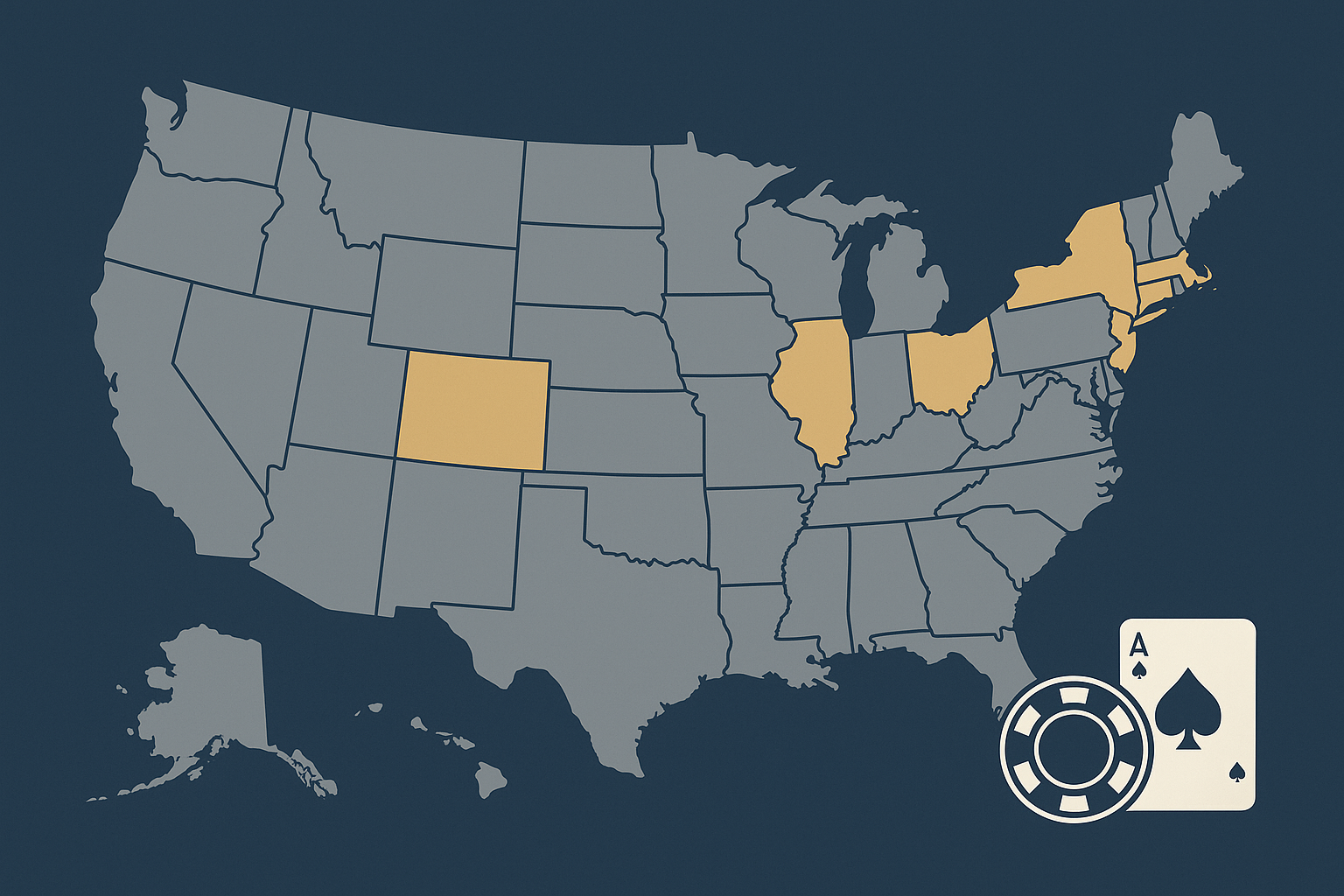
Short answer: whether iGaming is legal depends entirely on which state you’re sitting in. There is no nationwide ban and no nationwide permission. As of publication, seven states have legalized and launched real-money online casino play, one more allows online poker only, and the other 42 do not license internet casino gambling at all. Everything below is general information, not legal advice.
What is iGaming, and is iGaming gambling?
iGaming means playing casino games for real money over the internet, including slots, blackjack, roulette, baccarat, video poker, live dealer tables and online poker. Yes, it is gambling in the plain legal sense: you stake money on an outcome determined largely or entirely by chance, and the operator holds a built-in mathematical advantage (the house edge) on every game.
That house edge is the part people gloss over. A slot advertising 96% RTP returns about $96 per $100 wagered averaged over millions of rounds across all players, which leaves a 4% house edge. It is not a per-session promise, and no legal framework changes that math.
iGaming is also legally distinct from sports betting. Wagering on a game’s result is regulated under separate statutes in most states, often with different tax rates, different licence types and different launch timelines. A state can have sportsbooks on every phone and still prohibit online slots. Most do. If you want the basics of the sector itself, see our explainer on what iGaming covers.
Federal vs state iGaming regulation in the US
Two federal laws come up constantly, and both are narrower than their reputations suggest.
The Unlawful Internet Gambling Enforcement Act of 2006 (UIGEA) targets the money, not the player. It bars businesses from knowingly accepting payments connected to bets that are already unlawful under some other federal or state law. UIGEA did not create a new federal prohibition on casino games, and it explicitly leaves room for gambling that is legal and contained within a single state. That intrastate carve-out is the legal foundation for every regulated US online casino market operating today.
The Wire Act of 1961 predates the internet and prohibits using wire communications to transmit certain bets across state lines. Its scope has been argued over for years: a 2011 opinion from the Department of Justice’s Office of Legal Counsel concluded the Wire Act applies only to sports wagering, a 2018 opinion reversed that reading, and litigation brought by the New Hampshire Lottery led the First Circuit Court of Appeals to rule in 2021 that the Wire Act is limited to sports betting. The Justice Department did not take the case to the Supreme Court. Practically speaking, regulated state markets have continued to operate and expand since then.
What that leaves is state jurisdiction. Each state decides whether to authorize internet gaming, which regulator issues licences, what tax rate applies, which games are permitted, and how player funds and identity checks must be handled. Licensed operators use geolocation software to confirm you are physically inside state lines when you play, which is why a New Jersey account stops working the moment you cross into New York.
iGaming legal states: where you can play right now
Seven states license full online casino gambling. Nevada, despite being the biggest land-based casino market in the country, permits online poker only.
| State | Online casino launch | Games permitted online | Primary regulator |
|---|---|---|---|
| Delaware | November 2013 | Casino games and poker | Delaware Lottery |
| New Jersey | November 2013 | Casino games and poker | Division of Gaming Enforcement |
| Pennsylvania | July 2019 | Casino games and poker | Pennsylvania Gaming Control Board |
| West Virginia | July 2020 | Casino games and poker | West Virginia Lottery |
| Michigan | January 2021 | Casino games and poker | Michigan Gaming Control Board |
| Connecticut | October 2021 | Casino games (no online poker) | Department of Consumer Protection |
| Rhode Island | March 2024 | Casino games | Rhode Island Lottery |
| Nevada | 2013 (poker only) | Online poker only | Nevada Gaming Control Board |
Fully operational markets
New Jersey, Pennsylvania and Michigan are the mature ones. Each has multiple licensed operators, hundreds of slot and table titles, live dealer studios physically located in-state, and years of published revenue reporting from the regulator. New Jersey has run continuously since November 2013 and is where most US-facing platforms were first tested.
West Virginia and Delaware are smaller but fully functional. Delaware’s market runs through the state lottery in partnership with its three racinos, so player choice is narrower than in New Jersey.
Recently launched states
Connecticut opened in October 2021 under an arrangement involving the Mashantucket Pequot and Mohegan tribes, with two online casino brands rather than an open field. Rhode Island became the newest online casino state in March 2024, operating through the state lottery with Bally’s as the single authorized operator, which makes it the most tightly limited market of the seven.
States with pending launch dates
Here the honest answer is that there aren’t any at the moment. As of publication, no additional state has an enacted online casino law with a launch date on the calendar. Bills to authorize internet casino gaming have been introduced in recent legislative sessions in states including New York, Maryland, Illinois and Indiana, and several have advanced through committee, but none had become law. Introduction is not authorization, and headlines about a bill “moving forward” often describe a proposal that dies at the end of the session.
Two things worth separating out. Online lottery, daily fantasy sports and online horse race wagering are legal in far more states and are regulated under different rules, so their availability tells you nothing about casino legality. And so-called sweepstakes or social casinos, which use virtual currency models, operate in a legal grey area that several state regulators and attorneys general have been actively questioning.
iGaming vs sports betting: why online casino legality lags behind
More than 30 states plus Washington, D.C. have legal sports betting, and most of those allow it online. Only seven allow online casino games. The gap comes down to politics and money rather than technology.
Sports betting spread quickly after the Supreme Court struck down the federal ban (PASPA) in Murphy v. NCAA in 2018. It arrived with a ready-made pitch: leagues on board, broadcast partners, an existing illegal market to capture, and a product legislators could describe as entertainment attached to sport.
Online casino runs into harder resistance:
- Land-based casino operators and their unions often argue online slots cannibalize floor revenue and jobs, even though data from Pennsylvania and Michigan is contested on this point.
- Tribal gaming compacts complicate the picture in many states, since exclusivity agreements may need renegotiation before any commercial online launch.
- Online slots are continuous, high-frequency play available 24 hours a day, which raises sharper problem-gambling objections than a weekly parlay.
- Revenue-sharing fights between states, tribes and casino licensees stall bills more often than outright moral opposition does.
The practical takeaway for players: never assume that because a sportsbook app works in your state, its casino tab is legal there too. Licensed operators simply hide or disable the casino section in states where it isn’t authorized.
How to check if iGaming is legal in your state
Legal status changes by legislative session, so verify rather than rely on a list you read months ago, including this one. Four steps that take about five minutes:
- Go to your state’s gaming regulator directly. Search for your state name plus “gaming control board”, “gaming commission”, “division of gaming enforcement” or “lottery”. Regulators publish a list of licensed internet gaming operators, and that list is the authoritative answer.
- Check whether the licence covers casino games specifically. A site can hold a legitimate sports betting licence in your state and no casino licence. Read what the permit actually authorizes.
- Confirm the operator’s licence number in the site footer. Licensed US platforms display the regulator name and licence details, plus responsible gambling links. If you can’t find them, treat the site as unlicensed.
- Check state legislature records for pending bills. Most legislatures publish bill status online, which tells you whether a proposal has actually passed both chambers and been signed, or is merely introduced.
Offshore sites that accept US players without a state licence are a separate category. They sit outside any US regulator’s oversight, which means no state-backed dispute process, no audited RNG requirement enforced by a US agency, and no guarantee of payment. Legality aside, that’s the practical risk.
Age requirements and responsible gaming
Every state that currently licenses online casino gambling sets the minimum age at 21. That is stricter than the 18+ threshold some states apply to lottery tickets, pari-mutuel horse wagering or daily fantasy sports. Licensed operators verify age and identity through KYC checks at registration or before your first withdrawal, and accounts that fail verification are closed. Gambling is for adults only, and using someone else’s account or identity is grounds for confiscation of funds.
Regulated platforms are required to offer control tools: deposit limits, loss limits, session time limits, reality-check reminders, cool-off periods and self-exclusion. Several states also run a centralized self-exclusion list that blocks you across all licensed operators at once. Use these before you need them, not after.
Treat online casino play as paid entertainment with a negative expected return, never as income or a way to recover losses. If gambling stops feeling like a choice, help is free and confidential: call or text the national problem gambling helpline at 1-800-GAMBLER, which connects to local resources 24 hours a day, or visit the National Council on Problem Gambling for treatment referrals.
Frequently asked questions
Is iGaming legal in the US?
Partly. There is no federal prohibition on state-licensed online casino gaming, and seven states plus Nevada (poker only) currently license it. In the remaining states, real-money online casino play is not authorized.
Which US states allow online casinos?
Delaware, New Jersey, Pennsylvania, West Virginia, Michigan, Connecticut and Rhode Island allow real-money online casino games. Nevada permits online poker but not online casino games.
Is iGaming the same as gambling?
iGaming is a form of gambling, specifically casino gambling conducted online. The term is generally used for slots, table games, live dealer games and online poker, and it excludes sports betting, which is regulated separately.
How is iGaming regulated in the US?
By individual states. Each state’s gaming commission, control board or lottery licenses operators, sets tax rates and game rules, and enforces geolocation, age verification and responsible gambling requirements. Federal law (UIGEA and the Wire Act) shapes payment processing and interstate transmission rather than granting or denying permission to play.
This article is general information about current legal status, not legal advice. Laws change; confirm the position with your state regulator or a qualified attorney before you act on anything here.